Bald filterAm I going bald? Signs and what to do
Am I going bald? The early signs, and what to do about them
Everyone finds hair in the shower, and many hairlines move a little in your twenties without going any further. So how do you know if you are really going bald? Here are the signs that count, a simple way to track them, the Norwood scale doctors use, and your options at each stage, from treatment to a clean shave.

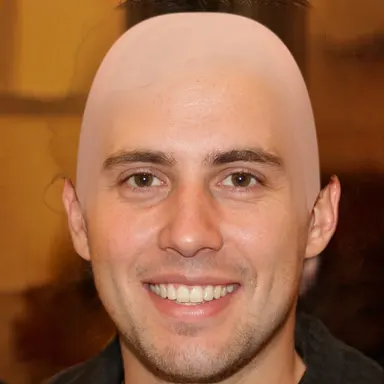
Would you look good bald?
- Real time
- 100% private
- Free, no sign-up
The early signs of balding
Receding temples
The corners of the hairline move back and form an M. It is the most common first sign in men.
A thinning crown
The whorl at the top of the head widens and the scalp shows through, often noticed first in photos or under a ceiling light.
Finer, shorter hair
Hair in the affected areas becomes thinner and lighter and stops growing long. Doctors call it miniaturization; it comes before the bald patch.
Scalp visible when wet
Wet hair clumps together and shows the skin. If you see more scalp than a year ago in the same light, take note.
Lasting shedding
Losing 50 to 100 hairs a day is normal. Clearly more, for several months, on the pillow, in the drain or on your hands, is worth checking.
Baldness in the family
Pattern hair loss is hereditary, on both sides of the family. Look at your father, your grandfathers and your mother's brothers.
Mature or receding hairline?
Between the late teens and about 30, most men's hairline rises by 1 to 1.5 cm and straightens a little. That is a mature hairline: it moves once, evenly, then stays put. It does not mean you are going bald.
A receding hairline keeps moving. The temples dig in deeper than the center, the hair at the front gets fine and see-through, and the change is still visible when you compare photos a year apart. A quick check: raise your eyebrows, place your index finger above the highest forehead wrinkle; a mature hairline usually sits within a finger or so of it.
Track it properly
- 1
Take reference photos
Front, both temples and the crown from above, with damp hair, in the same spot, under the same light.
- 2
Repeat every 3 months
Hair changes slowly: from one week to the next you only see your mood. Compare photos taken months apart.
- 3
Judge after 6 to 12 months
If the temples, the crown or the density have clearly changed, it is time to see a dermatologist.
The Norwood scale, in short
Doctors rate male pattern hair loss on the Norwood scale, from 1 to 7. It helps to describe where you are and to choose a treatment.
Stages 1 and 2
A full or mature hairline, with a slight recession at the temples. No visible hair loss.
Stage 3
A clear recession at the temples, sometimes with a thinning crown (3 vertex). The first stage considered balding.
Stages 4 and 5
The front and the crown thin out and the band of hair between them gets narrower.
Stages 6 and 7
The top is bald, leaving a horseshoe of hair on the sides and the back. Many men shave at this point.
Women: a different pattern
In women, hereditary hair loss rarely touches the hairline. The part widens and the top thins all over, while the front stays in place. It is rated on the Ludwig scale and is just as common, especially after menopause.
Because iron deficiency, thyroid problems and hormonal changes can look the same, a doctor's visit with a blood test comes first.
When it is not genetic
Sudden shedding
Two to three months after a fever, surgery, childbirth, a crash diet or a big stress, hair falls out all over. It usually grows back on its own within months.
Round bald patches
Smooth, coin-sized patches that appear fast point to alopecia areata, an autoimmune condition. See a dermatologist.
Tight hairstyles
Braids, tight ponytails or extensions pulling for years thin the edges. It can become permanent: loosen them early.
Deficiencies and medication
Low iron, vitamin D or thyroid hormone, and some medicines, thin the hair. A blood test finds it, and treating the cause brings it back.
What to do now
- See a dermatologist early: treatments save hair, they rarely bring back hair that is long gone.
- Ask about minoxidil and finasteride, the two treatments with solid evidence for pattern hair loss.
- Add a ketoconazole shampoo two or three times a week, a cheap and useful complement.
- Keep taking your reference photos to see whether the treatment works.
- Try a shorter cut: thinning hair looks fuller kept short.
- Look at the other option: see yourself with a shaved head.
Or stop worrying and see yourself bald
Plenty of men spend years fighting a losing hairline, then shave and wonder why they waited. Before you decide anything, bald-filter.com shows you bald live on your camera, for free and without uploading anything. Whatever you choose next, you will choose it knowing what the shaved look does for your face.
Frequently asked questions
At what age do men start going bald?
It can start any time after puberty. About a quarter of men with pattern hair loss notice it before 21, and around half of men have some by the age of 50.
Is my hairline receding or just maturing?
A mature hairline rises 1 to 1.5 cm in your late teens or twenties, evenly, then stops. A receding one keeps moving, digs in at the temples and the hair at the front gets finer. Compare photos a year apart.
Am I going bald if I can see my scalp?
Not necessarily. Fine or light hair, wet hair and harsh overhead light all show the scalp. What counts is change: more scalp than a year ago, in the same light, is a sign to check.
Can you stop balding once it starts?
You can often slow or stop it. Minoxidil and finasteride keep the hair you have in most men who use them, and regrow some of it. Hair that has been gone for years only comes back with a transplant.
Does baldness come from your mother's side?
Partly. An important gene sits on the X chromosome, which men get from their mother, but many other genes are involved on both sides. A bald father is a warning sign too.
How fast does male pattern baldness progress?
It differs a lot from one man to another. It usually advances slowly, over years or decades, often in phases of faster loss followed by calmer periods.
Would you look good bald?
- Real time
- 100% private
- Free, no sign-up
More guides
Bald filter for photos
Pick a photo and see the person bald in seconds. Free, no sign-up, and the picture never leaves your device.
Bald filter for webcam, Zoom and OBS
Put a live bald filter on your webcam for Zoom, Google Meet, Teams or Discord, free in your browser with OBS Virtual Camera.
Bald filter on TikTok, Instagram and Snapchat
The bald filter on TikTok, Instagram and Snapchat: what it's called, where to find it, and a realistic one to post anywhere.
Would I look good bald?
Would a shaved head suit you? Check your face shape, skull, beard and skin, then see yourself bald live with a free filter.
Bald with a beard: styles and tips
Shaved head and beard: the styles that suit each face shape, how to balance the two, and how to see the look on you.
Shaved head for women
Thinking of shaving your head? Face shapes, buzz cut lengths, what to expect, regrowth, and a free filter to see it first.
How to shave your head
Shave your head at home with clippers and a razor: tools, steps, the back of the head, mistakes to avoid and aftercare.
How to take care of a bald head
Shave your head without cuts or bumps, stop it shining or flaking, protect it from sun and cold, and know how often to shave.
Hair care: keep your hair healthy
The habits that protect your hair, hair loss myths, early signs of balding and the treatments that actually work.
Hair regrowth products that work
Minoxidil, finasteride, ketoconazole, laser caps, rosemary oil, biotin: what regrows hair and how long it takes.
Hair transplant or shaved head?
Hair transplant (FUE, FUT, DHI): cost, recovery month by month, who it suits, and when shaving your head is the better call.